DELHI EV POLICY: A BOLD BEGINNING FOR
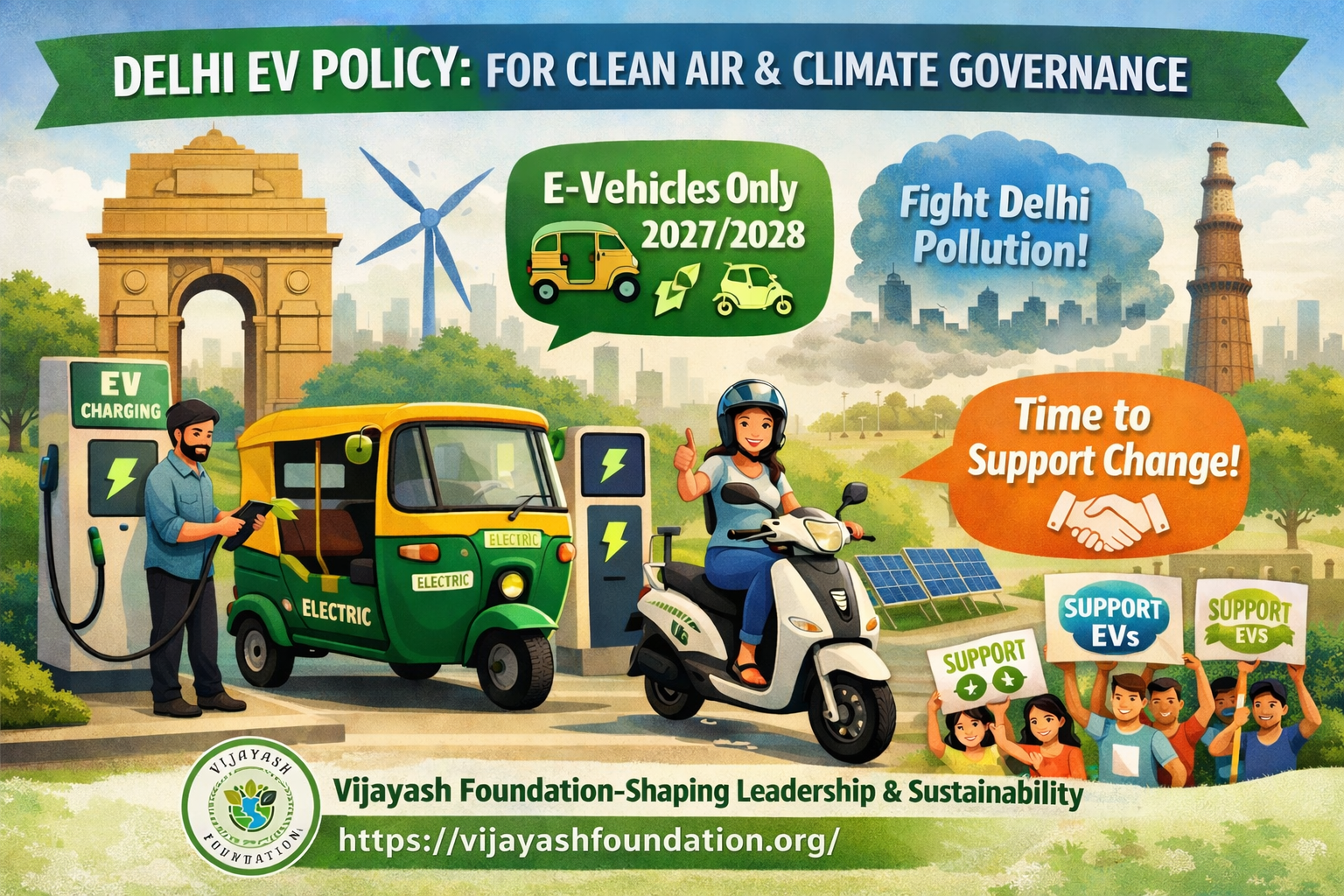
DELHI EV POLICY: A BOLD BEGINNING FOR CLEAN AIR & CLIMATE GOVERNANCE
The draft EV policy by the Government of Delhi proposes a decisive transition:
– Only electric three-wheelers from Jan 2027
– Only electric two-wheelers from April 2028
– Continued incentives to accelerate EV adoption
At Vijayash Foundation, we see this as a strong, timely, and necessary step in public interest.
WHY THIS MOVE DESERVES STRONG SUPPORT
– Urgent response to Delhi’s pollution crisis
Vehicular emissions contribute significantly (~23% in winters) to Delhi’s air pollution — bold action is no longer optional.
– Targeting the largest segment for maximum impact
Two-wheelers form nearly 67% of Delhi’s vehicles, making electrification critical for real, measurable improvement.
– From intent to implementation
This is climate governance in action — moving beyond dialogue to decisive execution.
– Policy-led transformation
History shows that clear policy direction drives innovation, investment, and ecosystem development.
– A necessary beginning
We cannot wait for perfect conditions — progress begins with bold decisions.
INDUSTRY CONCERNS vs PUBLIC INTEREST
While industry stakeholders, including Society of Indian Automobile Manufacturers and consultations linked to NITI Aayog, have raised concerns on:
• Market readiness
• Cost economics
• Product availability
These are valid—but transitional—challenges.
Public health, environmental sustainability, and climate commitments must take precedence over short-term business constraints.
This is also an opportunity for the auto industry to innovate, lead, and align with global sustainability trends.
INFRASTRUCTURE: A CHALLENGE, BUT NOT A ROADBLOCK
Yes, concerns exist around:
• Charging infrastructure
• Financing ecosystem
• Consumer adaptation
However:
– Government policy creates the ecosystem – infrastructure will follow intent
– Investment flows where policy clarity exists
– Delay in action will only increase environmental and health costs
At Vijayash Foundation, we strongly believe:
– Clean air is a fundamental right
– Sustainability is a shared responsibility
– Policy + Industry + Society = Real transformation
This policy is not just about EVs –
It is about health, environment, and the future of our cities.
FINAL THOUGHT
Instead of resisting change, let us support, collaborate, and accelerate this transition.
A sustainable Delhi is not optional — it is essential.
And every transformation begins with a courageous first step.
Let’s amplify this movement