
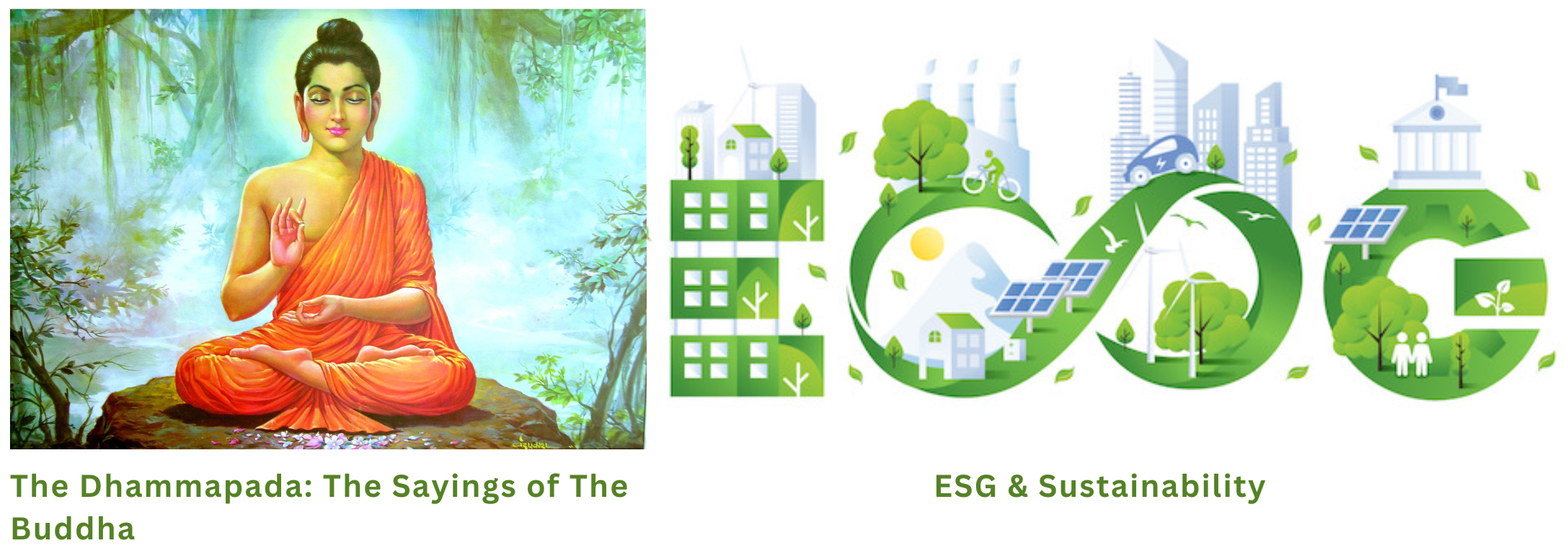
Dhammapada and Sustainability & ESG
The Dhammapada, a collection of verses attributed to the Buddha, offers timeless wisdom that resonates with modern principles of Sustainability and Environmental, Social, and Governance (ESG) frameworks. Its teachings emphasize ethical conduct, mindfulness, and compassion, which align closely with sustainable practices and responsible governance. Below, we will explore how the Dhammapada connects to Sustainability and ESG, and also touch upon parallels in other scriptures.
Dhammapada and Sustainability & ESG
The Dhammapada, rooted in Buddhist philosophy, promotes living in harmony with oneself, others, and the environment. Its relevance to Sustainability and ESG can be understood through several key themes:
- Environmental Stewardship (Environmental Pillar of ESG):
- The Dhammapada emphasizes non-harming (ahimsa) and interconnectedness, encouraging respect for all life forms. Verses like “All beings tremble before danger, all fear death. When you consider this, you will not kill or cause to kill” (Verse 129) advocate for compassion toward all creatures, which aligns with environmental sustainability by discouraging exploitation of natural resources or harm to ecosystems.
- Mindfulness, a core teaching, encourages awareness of one’s actions and their impact. For instance, practicing moderation in consumption (Verse 7: “He who is not content with what he has, though he possesses everything, is defeated by craving”) can be applied to reducing overconsumption, a key driver of environmental degradation.
- Relevance to Sustainability: These principles support reducing waste, conserving resources, and fostering biodiversity, aligning with goals like reducing carbon footprints and protecting ecosystems.
- Ethical Conduct and Social Responsibility (Social Pillar of ESG):
- The Dhammapada stresses virtues like compassion, generosity, and truthfulness. Verses such as “Hatred does not cease by hatred, but only by love” (Verse 5) promote peaceful coexistence and empathy, which are foundational to building inclusive, equitable communities.
- It also emphasizes self-discipline and responsibility for one’s actions (e.g., Verse 160: “One is one’s own refuge; who else could be the refuge?”), encouraging individuals and organizations to act ethically in social interactions.
- Relevance to ESG: These teachings support fair labor practices, community engagement, and social equity, which are central to the social pillar of ESG. For example, ethical treatment of workers and stakeholders mirrors the Dhammapada’s call for compassion and justice.
- Responsible Governance (Governance Pillar of ESG):
- The Dhammapada underscores integrity, wisdom, and accountability in leadership. Verses like “Better than a thousand hollow words is one word that brings peace” (Verse 100) highlight the importance of truthful and impactful communication, a key aspect of transparent governance.
- It also warns against greed and corruption (e.g., Verse 252: “The fault of others is easily seen, but one’s own is hard to see”), which aligns with ESG’s focus on ethical decision-making, anti-corruption measures, and accountability in organizations.
- Relevance to ESG: These principles encourage transparent, ethical governance structures, such as those required for corporate accountability, stakeholder trust, and regulatory compliance.
- Holistic Perspective on Interconnectedness:
- The Buddhist concept of dependent origination (everything arises interdependently) in the Dhammapada implies that human actions impact the environment and society. This aligns with the systems-thinking approach in sustainability, where environmental, social, and economic factors are interconnected.
- For example, Verse 116 (“Hasten to do good; restrain your mind from evil”) can inspire proactive efforts in sustainable practices, such as adopting renewable energy or reducing waste.
Vijayash Foundation Team
+91 8076757301