When the Himalayas Cry, Humanity Must Listen
Nepal’s floods are a warning for the world
The devastating floods that struck Nepal on 26 August 2026 are more than a humanitarian tragedy. They are a stark reminder of the growing risks faced by mountain communities in a changing climate.
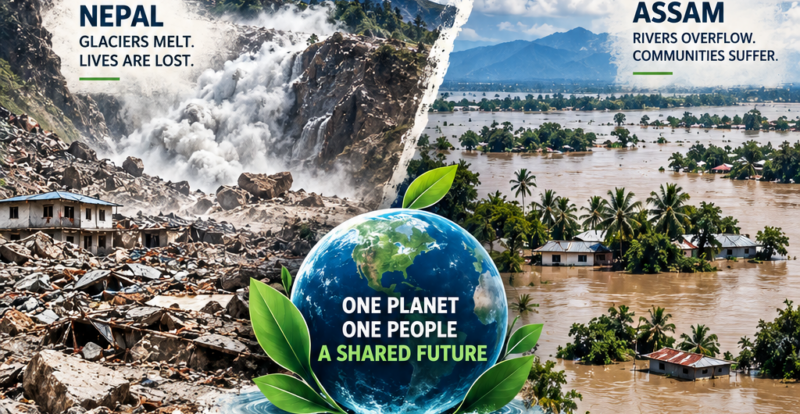
A glacier-related collapse triggered an extraordinary surge of ice, rock, mud and water through Nepal’s river systems, destroying homes, infrastructure and livelihoods. The latest UN figures report 1,367 confirmed deaths and more than 5,000 people still missing. Nepal’s estimated losses have already reached billions of dollars.
Across the region, Assam too continues to experience devastating floods, highlighting the vulnerability of the wider Himalayan–Brahmaputra ecosystem. Extreme rainfall and changing climate conditions interact with erosion, deforestation, wetland degradation and development pressures, increasing the impact on communities.
Climate change is no longer a distant warning
Such disasters cannot be attributed to climate change alone. But warming temperatures, changing rainfall patterns and destabilisation of glaciers and mountain ecosystems can increase the risks and consequences of extreme events.
The deeper concern is climate injustice.
Countries and communities that have contributed relatively little to global emissions can face some of the greatest human and economic losses. Nepal has therefore approached the UN Loss and Damage Fund and is seeking substantial international assistance for recovery and reconstruction.
The United Nations has already launched a US$49.6 million emergency appeal for immediate humanitarian assistance. This is welcome, but the challenge extends far beyond emergency relief.
Nepal must not rebuild this enormous loss alone
Vijayash Foundation strongly believes that the United Nations, developed nations, international financial institutions and global climate-finance mechanisms must come forward with greater urgency—not only for food, shelter and medical support, but for restoration, reconstruction, resilient infrastructure, ecosystem recovery, early-warning systems and long-term climate adaptation.
This is not simply charity.
It is human solidarity, climate responsibility and climate justice.
And the world must examine its priorities
While vulnerable communities are fighting floods and rebuilding their lives, the world remains deeply occupied with geopolitical conflicts, strategic rivalries and competition.
Conflict consumes enormous resources.
Climate disasters consume lives and livelihoods.
Money is lost.
Lives are lost.
Humanity is lost.
Nature is lost.
And valuable time to act is lost.
The planet, however, does not recognise our divisions.
Glaciers do not carry passports.
Rivers do not respect borders.
Climate risks do not distinguish between rich and poor.
COP conferences have repeatedly called for greater climate action, adaptation and Loss & Damage support. The time has come to translate those commitments into visible action on the ground.
From Climate Compliance to Climate Responsibility
We must move:
Reaction → Prevention
Relief → Resilience
Compliance → Responsibility
Confrontation → Cooperation
For governments, businesses and institutions, ESG and Sustainability must mean more than reporting. They must mean protecting people, preserving nature and building resilience.
Vijayash Foundation stands with Nepal
VF wholeheartedly stands with the people of Nepal and supports Nepal’s call for meaningful global solidarity and climate justice.
The Himalayas are warning us.
Assam is reminding us.
Nature is speaking.
Can humanity spend less on confrontation and more on protecting people and the planet?
Let us move from awareness to action, ambition to accountability, and confrontation to cooperation.
Dr. Deepika Tiwari – General Manager, “Sustainability & Value Creation”
Vijayash Foundation
An association of ESG professionals working and promoting ESG, Sustainability, Net Zero and Viksit Bharat.